ACM Books Publication

Geospatial Data Science

A hands-on approach for building geospatial applications using linked data technologies

Editor: Professor Manolis Koubarakis

Published by ACM Books, this comprehensive guide teaches readers how to develop geospatial applications using the principles and tools of geospatial data science.

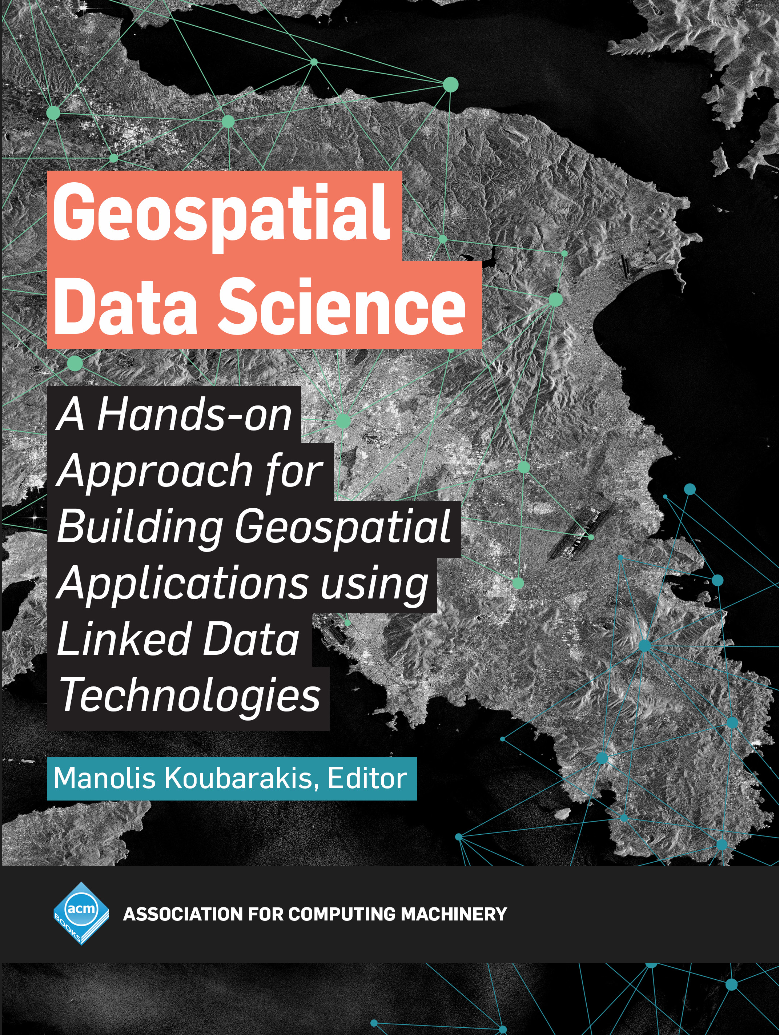
Geospatial Data Science Book Cover

Book Details

  1. Introduction
  2. Geospatial Data Modeling
  3. Legacy Geospatial Data Technologies
  4. Ontologies and Linked Data
  5. Geospatial Ontologies
  6. Linked Geospatial Data
  7. Querying Geospatial Data Expressed in RDF
  8. Visualizing Linked Geospatial Data
  9. Transforming Geospatial Data into RDF
  1. Interlinking Geospatial Data Sources
  2. Geospatial Ontology-based Data Access
  3. Incomplete Geospatial Information
  4. Geospatial RDF stores
  5. Geospatial Knowledge Graphs
  6. Question Answering Engines for Geospatial Knowledge Graphs
  7. Putting it All Together: a Data Science Pipeline for Linked Earth Observation Data
  8. Conclusions

The purpose of this book is to teach the readers how to develop geospatial applications easily based on the principles and software tools of geospatial data science. Geospatial data science is the science of collecting, organizing, analyzing, and visualizing geospatial data. The book introduces a new generation of geospatial technologies that have emerged from the development of Semantic Web and the linked data paradigm, and shows how data scientists can use them to build environmental applications easily.

This book takes the view that data scientists only need to be experts in semantic and linked data technologies. These technologies are typically covered at the advanced undergraduate or graduate level through a course on "Semantic Web and Linked Data" or through some dedicated lectures in a course on "Database Management Systems". Semantic technologies are not specific to the geospatial domain, but they have recently been extended for modeling geospatial domains.

The strong point of semantic technologies is that they do not deal with data formats or other low level details of the data. Instead, they allow a data scientist to model their application at the conceptual level using well-known concepts like objects, classes, and properties that most data scientists or software developers are familiar with today. They also enable a data scientist to interlink datasets containing information about the same thing (e.g., a dataset containing information about roads in Crete can be interlinked with a dataset containing land cover information about Crete).

Once geospatial semantic technologies (geospatial ontologies, stRDF, stSPARQL, GeoSPARQL, OBDA mappings) are mastered using the book, the data scientist may use them to model their data as linked data. If the original data the data scientist needs to work with is not in linked data form, it can be transformed into linked data easily using the right tool. There is also the option of not transforming the dataset into linked data, and yet access it like it was a linked data source! Semantic technologies can then be used to analyze and visualize the data with the help of appropriate linked data tools. Applications can also be built very easily. Some applications will be just a sequence of GeoSPARQL queries!
We would like to acknowledge the support of our employer, the National and Kapodistrian University of Athens. In addition, we would like to thank the European Commission, the Greek General Secretariat for Research and Technology and the Hellenic Foundation for Research and Innovation for their generous funding of the authors' research in geospatial data science since January 2010 through projects TELEIOS, LEO, MELODIES, Optique, SCARE, BigDataEurope, Copernicus App Lab, GeoQA and ExtremeEarth.

We would like to thank many collaborators from these research projects who provided insightful comments on our work and used in their institutions our geospatial data systems. We are also grateful to the students of the graduate course "Knowledge Technologies" at the Dept. of Informatics and Telecommunications of the National and Kapodistrian University of Athens from 2012 until today. They are the ones who first faced the exercises in this book and its Web site.

Manolis Koubarakis would also like to thank his colleagues Izambo Karali and Takis Stamatopoulos for taking over the teaching of "Knowledge Technologies" and "Artificial Intelligence" in 2014 and 2018 when he was on sabbatical leave, in the second occasion, for writing this book.

Finally, we would like to thank the people at ACM for giving us the opportunity to write this book and for guiding us through to completion.

Contributors

Editor

Prof. Manolis Koubarakis

National and Kapodistrian University of Athens

Chapter Contributors

Konstantina Bereta, Dimitris Bilidas, Theofilos Ioannidis, Nikolaos Karalis, George Mandilaras, Charalampos Nikolaou, Despina-Athanasia Pantazi, George Papadakis, Dharmen Punjani, George Stamoulis, Eleni Tsalapati

Key Features

What makes this book unique and valuable

Hands-on Approach

Practical examples and exercises that guide readers through real-world applications of geospatial data science.

Linked Data Technologies

Comprehensive coverage of semantic web technologies and their geospatial extensions.

Geospatial Applications

Learn to build applications using linked geospatial data and semantic web technologies.

Modern Tools

Integration with state-of-the-art tools and platforms developed by our research team.